

A place to feel seen, make sense of what you’ve carried, and begin to reclaim your story.
Moral injury often leaves people with more than just pain: it leaves them a story of courage, and a story of betrayal. A story of being silenced, betrayed, shamed, or pushed beyond their values in systems that asked too much and gave too little. And a story of the after: what happened after, what aided survival, and what is still carried.
The stories we carry shape what we believe is possible. Moral injury deserves to be named, witnessed, and re-authored. When we come together in the sharing of story, we find strength, validation, and connection. This is why the narrative approach is so helpful. Our stories matter, and in our stories, we find solidarity and meaning. Meaning helps us continue on.
This project isn’t built yet, we will build it together. We’re not launching a service. We’re not prescribing a solution. We’re starting with story. The Moral Injury Centre isn’t a centre in the traditional sense. Right now, it’s a gathering point. A listening space. A slow-building archive of the moral pain carried by those who work in systems that hurt the very people they’re meant to protect.
If you’re ready to share, you’re welcome here. And if you’re not, you still belong in this space.

Narrative Holding
Through collaborative conversations, storytelling, outsider witnessing, and meaning-making, narrative practice helps people re-author their identity in the aftermath of moral harm. It restores agency, reconnects people to their values, and offers language where silence once lived.
Training
Our training is designed for those working at the frontline of care, education, health, and justice—where moral injury often goes unnamed but deeply felt. Grounded in trauma theory, narrative practice, and lived experience, our training is not just informational—it’s transformational.
Consulting
We work with organisations to identify, name, and respond to the impact of moral injury within their systems, teams, and culture. Through consultation and narrative-based frameworks, we support meaningful change that restores integrity and trust.
Narrative Research
We conduct narrative research to surface the lived realities of moral injury—centering the voices often left out of policy, data, and reform. Our approach honours story as evidence, using narrative inquiry to inform ethical and moral practice, systemic change, and trauma-responsive innovation.
Holding On, Holding Out
A Narrative Series on Moral Injury
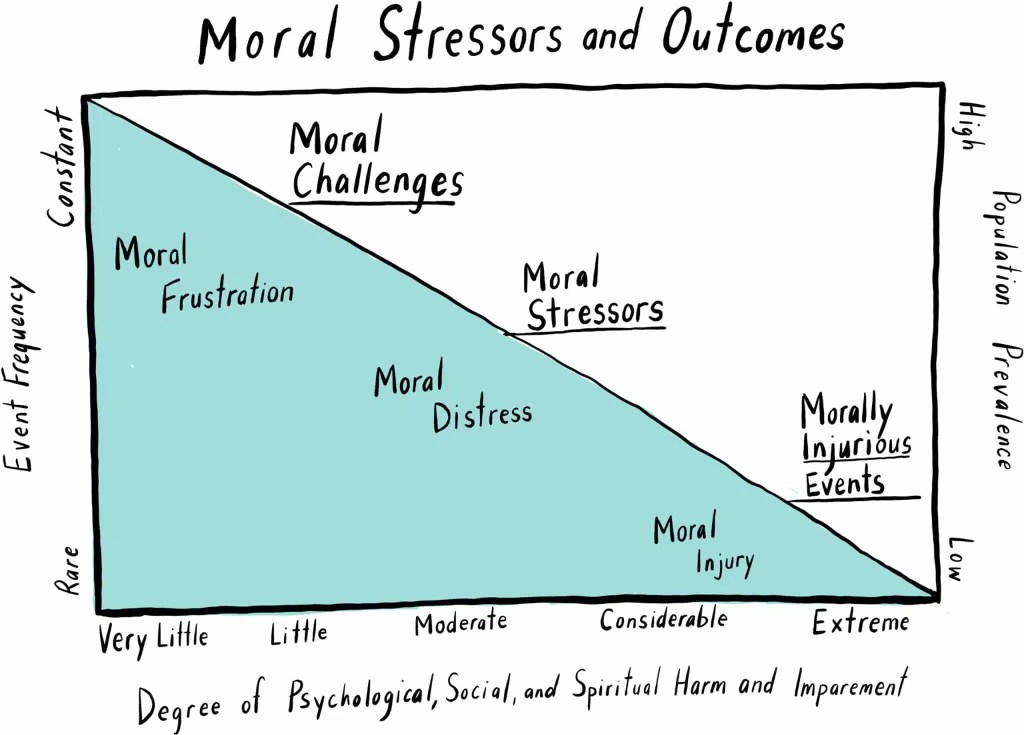
This series is about what people do when they are faced with impossible choices—when the values they hold are violated by the systems they work in, or the communities they serve.
Why this series?
When people tell stories of moral frustration, distress, and injury, they are often risking more than vulnerability. They are risking relationships, reputations, systems of power. These stories are not always safe to tell, but they are essential to name.
This series exists because there is a deep absence of support for people living with moral injury, especially through narrative approaches, despite narrative therapy being one of the four evidence-supported responses to moral injury in current literature.
We need a space to speak truth: safely, ethically, and collectively.
We need frameworks that recognise the strengths, acts of resistance, and values that people held, even when systems failed them.
Want to contribute?
If you have a story of moral injury—anonymous or named, written or spoken—I invite you to be part of this series.

We’re building a community where those impacted by moral injury can find safety, resonance, and reflection—without needing to explain their pain.
Here, recovery isn’t about fixing what’s broken, but reclaiming what still matters, together.
Blog

Being able to safely share my story made me feel validated and see it wasn’t my fault. I stood up for what was right and got hurt.
Anonymous research participant-LinkedIn

Contact Us
Your message has been sent

Subscribe to
Get our News
The Moral Injury Centre invites you to be a champion for moral injury! Collaborate with us to create a world where no person is left behind.
 Moral Injury Centre